
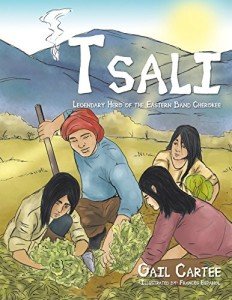
Tsali---Self-published book by Gail Wofford Cartee
- How many self-publishing companies or products did you investigate before choosing? What factors led to your choice?
- How many up-front costs did you incur to publish your book?
- How much control did you maintain over the process (editing, revision choices, cover design, illustrations, book type setup (font, size of print, etc.), book description for marketing purposes, etc.)?
- Did you hire a professional or use services provided by the self-publishing company for any of the following?
- Cover design - I chose from their illustrations. There were 10 "free" illustrations for the book.
- Illustrations - The publisher chose an illustrator and they were supposed to use my detailed form. I was given 1 free edit of pictures. The first set were way off. US Army uniforms were modern with hard shell hats and AK47 rifles, instead of representing 1838. Log cabins were scouting-type vacation cabins instead of log cabins. I copied detailed internet pictures and sent them for the second set of illustrations. They and I still overlooked one AK47.
- Editing - Editing was done by myself and two critique groups, so there were about six sets of extra eyes on the manuscript.
- Layout/design - I placed the pictures in the manuscript.
- Did you self-publish in print or e-book format, or both? Did the self-publishing company (if used) provide software services to create book files for printing or e-book conversion of your manuscript?
- Is the print book being marketed in stores?
- From your first self-publishing project, what advice do you have for authors who are considering embarking on a self-publishing adventure?
- Have honest open conversations with others who have self-published.
- Submit to as many traditional publishers as possible.
- Network with publishers at conferences.
- Consult publishing guides such as The Christian Writers Market Guide, The 2017 Guide to Publishers, and The Children's Market Guide.
- List ways you can market your book: schools, libraries, churches, festivals, etc.
- Evaluate the amount of money you are willing to invest and know the price per book.
- Consider hiring your own illustrator or ask for samples of the illustrations from the actual illustrator the service plans to use for your book.
- Don't agree to self-publish without investigating every possible traditional outlet.
- Don’t ignore advice from critique groups, editors, or traditional publishers.
- Don’t allow a publisher to push you into buying extras.
- Don't feel that you have to accept less than quality work from a publisher.
- Don't allow a publisher to rush your decisions. You are paying for this.
- Don't assume a publisher's affiliation means quality or honesty.
- Don't expect sales without lots of effort on your part.

Gail Wofford Cartee
Gail Cartee comes from a family of story-tellers, which sparked her interest in writing. She recently self-published Tsali: Legendary Hero of the Eastern Band Cherokee, a historical-fiction picture book for ages eight and up. Gail is currently working on picture books about her beloved Appalachia. Find her online at www.GailCartee.blogspot.com.
NOTE: Our thanks to Gail Cartee for this report. We’ll feature other writers’ self-publishing accounts in future posts. D. DeCiantis
Next in series: Laurie Gifford Adams.
Gail, your interview was very helpful. Thank you for sharing the details of your experience!