
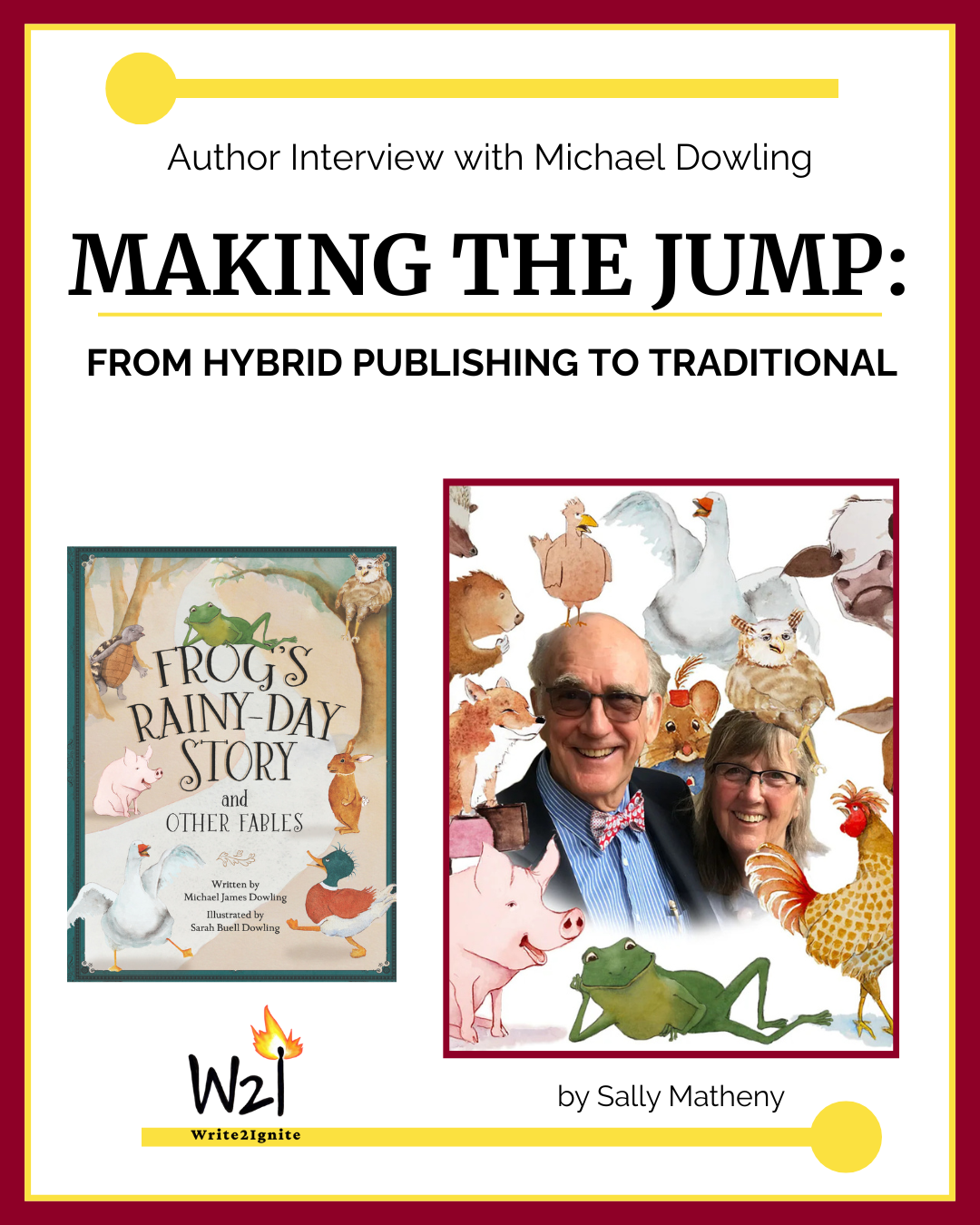
Today, we have a special bonus post on Michael Dowling's experience with hybrid and traditional publishing. Want to learn more? Don't miss our September Master Class with Darcy Pattison on self-publishing. Registration is now open.
Interview
Sally: "Teaching Sound Biblical Principles to the Next Generation" seems to be a key focus of your book. Why is the message so important in today's world?
Michael: Sarah and I are both in our eighties, and we have seen tremendous changes in our culture. When I was attending a public elementary school in the 1940s, we used to sing “Fairest Lord Jesus” frequently in the morning assembly. Today, many kids are growing up without exposure to the Bible. They know virtually nothing about Moses, Abraham, and Daivid, not to mention Jesus.
The spiritual hunger exists in the next generation because God put it in all of us, but sound biblical teaching is lacking. Personal lives are being eternally lost, and everyday life is getting more confusing, chaotic, and combative. The disaster is amplified when today’s parents try to limit how their own parents can interact spiritually with their children. We hope that our book will help to overcome these barriers by teaching biblical truths not only to today’s grandchildren, but also to their parents.
Sally: What background do you bring to the creative process?
Michael: For the past 25 years, I served as a professional ghostwriter of approximately 25 books for thought leaders. Also, I have written other books of my own. “Boosting Your Pet’s Self-Esteem,” which was published by Macmillan, is a humorous satire of our culture’s unbiblical emphasis on self and self-help.
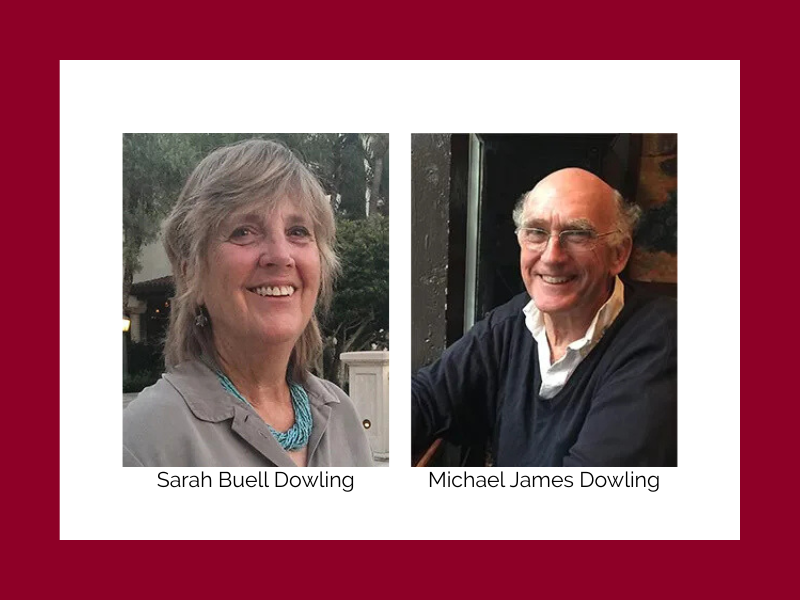
My wife, Sarah Buell Dowling, illustrated the book. In addition to being a fine illustrator, she is an outstanding oil and watercolor painter. Her website is www.SarahBuellDowling.com.
Sally: What was it like to collaborate as a husband-and-wife team?
Michael: Sarah and I love collaborating on books. After I do the initial writing, she helps me refine the ideas. When she begins the illustration process, I will usually tell her what I have in mind. Then she will do something that is far better than I could envision. I love the humor and whimsy that she adds, and she enjoys my sense of humor. We energize each other in a positive way.
It hasn’t always been easy working creatively as husband and wife. For about seven years after we were married back in 1979, we founded and operated a business that manufactured and sold the stuffed animals that she created. We were new Christians back then, and we would often argue. When she was angry at me, she stopped designing, and the company with its more than a dozen employees would essentially cease functioning. God used that experience in the early days to break us. For the past thirty-plus years, we have thoroughly enjoyed working together. However, Sarah still hates meetings!
Sally: What obstacles did you have to overcome while developing this book?
Michael: I have an MBA, and when I worked in business before Sarah and I were married, the business projects I worked on needed to be done. There was an external motivation. But the creative process is different. The ideas and the motivation must come from within.
When I was writing Frog’s Rainy-Day Story and Other Fables, I did not know whether my investment of time and effort would ever bear fruit. I kept at it because before I became a Christian, I was involved in New Age spirituality and Eastern religions. I knew the dangers, and I was motivated to combat them. In the creative process, one obstacle that must be overcome is the need for motivation.
Getting Sarah to do the original illustrations seemed like an obstacle at the time. After I had written most of the fables, I encouraged her to begin illustrating them, and she made somewhat of an effort, but she didn’t get very far. It was frustrating to me.
One day when she walked into a shop that sells artists’ supplies, a clerk she had never seen before walked over and out of the blue asked her if she had seen this new product that combines watercolor paints and charcoal. She bought a few colors to sample, and when she tried illustrating with them, they gave her exactly the look she had been looking for. It was really a divine appointment. Sarah didn’t know this watercolor product existed; this clerk who was a total stranger had no reason to think she needed it. What had appeared to be an obstacle turned out to be a matter of waiting on God’s timing.
Another obstacle that we had to overcome was getting the book published. [We had to raise the funds] from friends and supporters to pay for the printing and other costs. This took considerable effort. I made numerous calls and wrote numerous letters. People were generous, God was faithful, and we raised what we needed.
Selling the book to the reading public was another obstacle that took considerable effort. We primarily sold copies on our website and at various homeschool conferences, Christmas craft shows, ministry conventions, and other events. Because we were highly motivated, we persevered. By God’s grace, we succeeded.
Sally: Please tell us more about your book’s journey from a hybrid publisher to a traditional publisher.
Michael: I initially spent a fair amount of time looking for a traditional publisher. When we were nearing completion of the book, I contacted Focus on the Family to see if they would like to publish it. They were my first choice because I felt they could do more than simply publish the book. I hoped that they would also develop programs that encouraged families to use the book at home and churches to use in their educational programs. Focus wasn’t interested, so we hybrid-published the book with Carpenter’s Sons Publishing in Nashville for the next four years.
With hybrid publishing, we were responsible for writing the book and getting the cover designed and the interior laid out. We also paid for the printing. Carpenter’s Sons coordinated the printing and the distribution. Unlike traditional publishing, we retained all rights to the book. This allowed us later to have it published by a traditional publisher.
[Hybrid publishing] has been an exciting journey. I’ve enjoyed selling the book from our booth at various events. I also raised money from time to time so we could print more copies.
During [the first] four years, we revised the book four times, and Sarah sent out a monthly update to people who had purchased the book. These email updates featuring the characters in the book typically had an open rate in excess of 60%. It was very helpful that during this time we were able to keep improving the content of the book.
Sally: How did your book get picked up by a traditional publisher?
Michael: I didn’t give up on Focus on the Family. Whenever we were exhibiting at a conference where Focus was also exhibiting, I would give their representatives a copy of our book to take back home for publishing consideration. After four years, God opened the door at Focus.
In March of this year, they notified us that they would like to publish it in conjunction with Tyndale House Publishers. God’s timing was perfect!
Sally: What are some of the valuable lessons you've learned during the publishing journey of Frog's Rainy-Day Parables? Is there anything you would have done differently? Any advice for first-time children's book writers who are seeking custom publishing?
Michael: I don’t think there is anything I would want to do differently. My advice to first-time children’s book writers is to have plenty of motivation. Writing a book for children may sound simple, but it isn’t. The financial rewards are very modest, so you need to have another motivation.
Sally: I mentioned in a previous blog post about how families can use this book. Do you have recommendations on how churches can use it?
Michael: Frog’s Rainy-Day Story and Other Fables is a great book for churches to use in their Sunday school classes. It has nine fables, which makes it an ideal summer curriculum. When the family has a copy of the book at home and reads it as a family, this reinforces the learning that the child gets at church. I call Frog’s Rainy-Day Story and Other Fables “an apologetics book for adults disguised as a children’s book. Preteens, teens, and adults love the book. They learn how to recognize the unbiblical themes that permeate our culture and combat them with God’s truth.
Discussion questions for each fable are in the book. Additional sets of questions for children, [teens, and adults] are on the book’s website. A leader’s guide that gives helpful suggestions for the teacher or parent leading the discussion is also available free on the website.
Sally: Is there anything else you'd like to share?
Michael: We are thankful for all the people who have helped and encouraged us along the way. We could not have done this alone. The journey has often been arduous, but God has used it to strengthen our faith. Even though we are in our eighties, we are blessed with good health and still working full-time. We resonate with the following words of Psalm 71:18:
“So even to old age and gray hairs, O God, do not forsake me, until I proclaim your might to another generation, your power to all those to come.”
Originally posted on Sally Matheny's blog.

Motivated by the power of story, history, and His Story, Sally Matheny’s passion is telling the next generation wondrous things.
Her nonfiction writing appears in worldwide, national, and regional publications.
Learn more at SallyMatheny.com., where you’ll find encouraging blog posts, book reviews, and free resources.
Wonderful interview! The Dowling’s journey to publication and writing is interesting. Thanks for sharing.
Great interview! It’s so cool that they collaborate on book projects. My hubby doesn’t read any fiction, even mine! He’s just not a reader, except for the rare nonfiction. He does read the Bible regularly. And when he’s not reading it, he’s listening to it on his phone.