


My youngest daughter invited me to my very first Escape Room game the other day. As a mystery fan, I was excited—and a little apprehensive. Would I understand all the clues? Would I be asked things I had no concept of? Would I be able to complete the game in the time allotted? Would I have fun? It was definitely a memorable experience, and a challenging one. And I took away some great lessons to help improve the writing process.
Know Your Objective

Our game started with our objective. We were told what our “mission” was, and then we had to proceed to find hidden clues to move us forward. One thing led to another. As writers, we need to let our readers know what is going on in the story so they will want to turn the page. We want to give them enough information, yet not so much that they already know what’s going to happen at the end of the book. And we don’t want to overwhelm them with so much content that they get confused as to who said what or what elements are important. Give them enough to move the story along.
Be Aware of Time

The timer was set for an hour. That is always a factor when you’re in an Escape Room. You are consciously aware of the time, especially since you don’t know how long the game will take. In our case, once we finished one room, we entered another to solve more clues—with the clock still counting down! And in the second room, once we thought we had the solution, another problem presented itself, making the tension spike as we were given a major plot twist.
As writers, there are two time factors to be concerned with. The first is pacing. You don’t want to present information too slowly because the reader will get bored. But at the same time, you don’t want to present so many facts all at once that the reader doesn’t know how to balance and process everything.
The second thing to consider is a sense of urgency. A conclusion needs to be found in a particular amount of time because something will happen if it doesn’t. If you give your reader enough of a problem to solve, then the story will carry along nicely until the end.
Make It Immersive
An Escape Room takes all of your concentration. You have to consider EVERYTHING. What stands out? What patterns am I seeing? What doesn’t look right? Does that poster mean anything? Why is this thing here? Believe me, my daughter and I were very engaged in the process. And that’s what we want from our readers. We need to write in such a way that they are fully immersed into the story—with its plot, with its characters, with its conflicts. Everything needs to matter. And if it doesn’t matter, or will confuse the reader, don’t write about it.
Make the Ending Worth It

My daughter and I had worked hard to find the clues. We went from one thing to the next, trying to figure out solutions and solving puzzles in order to move ahead. Yes, the hosts did give hints now and then on mounted computer screens when they saw we were struggling too long—but these kept us on track. And when that final objective was reached—Wow. So rewarding!
We want our readers to have had an amazing experience when they finish our stories. We want there to be a satisfying conclusion so they can walk away feeling, “Now that was some great writing!”
Is it possible to get there? Yes! But good writing takes hard work on our part, and it is very helpful to get feedback from others—such as in a critique group—where you can learn and improve. Putting time and energy into your writing will make it possible to create a story that is enjoyable and rewarding.
And if you have time, try an Escape Room. Not only will it challenge your problem solving skills, but it may inspire your writing even more.
How have “out of the box” experiences inspired your writing?
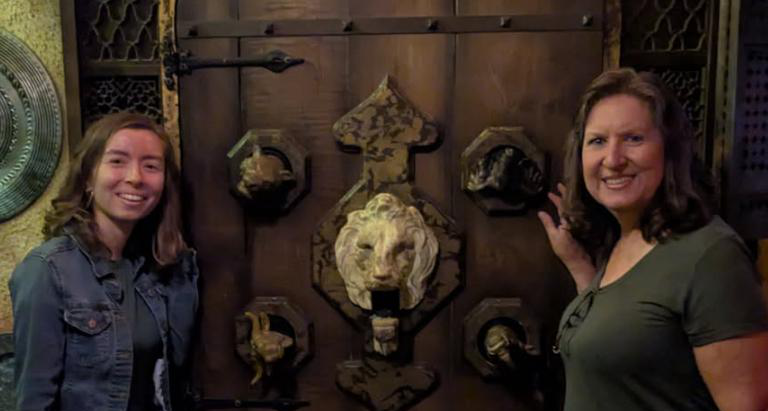
Catherine L. Osornio (on the right in the above photo) has written inspirational articles for a women’s ministry newsletter, over 200 leveled reader stories for a school’s reading program, fiction and nonfiction articles for Clubhouse and Clubhouse Jr. magazines, The Declaration of Independence from A to Z, Thunder Comes a Rumblin’, Mosquitoes Infect!, Danger on Martin Mountain, plus various work-for-hire projects.A former elementary school librarian, Catherine is passionate about sharing the love of reading. She enjoys cartooning, illustration, and reading kids’ books. Email her at CLOsornio@verizon.net or visit her at www.catherineosornio.com.
Unsplash photo credits: Peter Herrmann, Karla Hernandez, Ralph Hutter, and Benjamin Davies.
8 Responses
Catherine, thank you for the great comparison between our writing and an escape room. Sometimes, I feel like I’m in the room without any way of escape! 🙂
Thankfully, we can ask the Lord to inspire us and give us that creativity to get us out of any situation! He has never failed to provide in some way, shape, or form!
Loved this. Fun, engaging, and informative.
Thanks, Allia!
I’ve always been scared of Escape Rooms–a bit of cluster phobia, I suppose. But you made it sound fun and really applied it to writing. Kudos!!
We were so busy trying to solve all the clues that being in “close quarters” wasn’t even in our thoughts. You might consider it. It was so much fun!
This is fantastic! My family gets together now and again to do escape rooms. My granddaughter, who is a wiz at these things, gave us a team name: The Dumbledorks. We love it. (I am really bad at escape rooms. It’s good that I have people.)
Fun name! My sons are interested in doing one with us, so that is in the works 😀