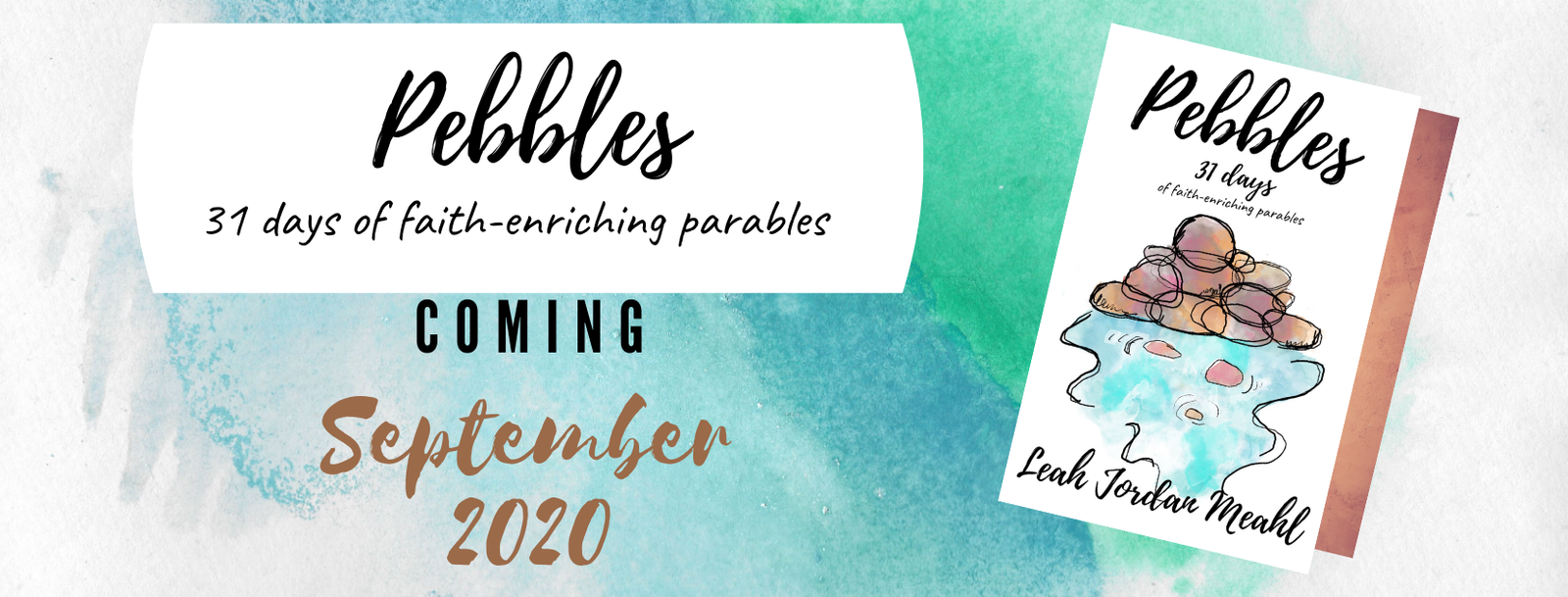
Pebbles and the Importance of Illustrations

How would you explain the love of God? Or the grace of a savior? How would you describe life as a Christian to a believer vs. a non-believer?

I typically revert to storytelling. Why? Because of illustrations. That’s what I set out to do with my new book, Pebbles: 31 days of faith enriching parables.

The Bible is rich with principles, and for those who love Jesus, it provides a fulfilling course of action for everyone. Jesus, knowing that we could just barely fathom the depths of the Bible’s mysteries, taught people the truth through, you guessed it, parables.

What’s a parable? A story that illustrates a moral or spiritual lesson.

So, why did the Teacher of Teachers use such illustrations and why should we follow suit? Here are my top three reasons.

  1. Illustrations are provocative

Stories have images and these images make us feel as well as think. As humans, we tend to connect with feelings. Instructions have a set of directions, but stories have a set of symbols. The creative nature stirs up something within us which then has a greater impact in the long run.


  1. Illustrations last longer

Because illustrations provoke thoughts and feelings, they last longer in our brains. How many times do we remember stories over sermons? Illustrations capture our attention and establish a connection to the underlying message. That connection allows our minds to return to that story or lesson when we need it the most.


  1. Illustrations are engaging

Sometimes, we have to work at something to understand it. Jesus knew that. If He simply spelled it out for us, we wouldn’t have to challenge ourselves or seek out anything. His parables have many layers and they offer new discoveries every time we read them. Exercising our critical thinking skills gives us a better appreciation of the meaning once we figure it out.


I’ve written Pebbles as a devotional of illustrations for fellow believers. The 31 modern parables will encourage, engage, and challenge your faith as you seek out the Biblical principles hidden within its pages.

Pebbles: 31 days of faith-enriching parables releases September 25th, 2020 and it will be available on Amazon.

Which parable from Jesus is your favorite? Let me know!


Leah Jordan Meahl writes to encourage both the rooted and the wandering Christian to go deeper. She’s a born and bred Jesus-follower hailing from Greenville, South Carolina. She’s a lover of devotional writing as well as fiction. Her newest book Pebbles: 31 days of faith-enriching parables is set to release September 2020. Feel free to visit her blog here. And ‘like’ her on Facebook here.

Picture-Driven Stories: Learning to Think in Pictures

“A picture book illustrator needs to tell a story with pictures. A picture book author needs to show the same story with words.”Jean Matthew Hall 

When I attended last year’s Write2Ignite conference, I went to Jean Matthew Hall’s discussion, What is a Picture Book. One of her main points was that a true picture book tells the story through both the illustrations and the words. Without either, the story would be incomplete.

When the illustrations build the story, rather than merely reflecting the words, it adds a layer of magic and delight to the book. But while it’s easy to recognize that pictures and words work together to make great stories, it’s sometimes hard to write a book designed to be accompanied by images (especially if you aren’t an illustrator). In order for pictures to help tell the story, the words have to leave enough unsaid.

As a beginning picture book writer, I struggle to leave details unsaid. My brain wants to describe everything, leaving no creative space for a future illustrator. The words feel like the heavy-lifters, so I don’t want to leave too much work for the pictures to do. I struggle with deciding what to show with my words, and what to leave for the pictures to tell.

What has helped me to look at my story drafts differently is reading picture-driven stories.

Picture-driven stories remind me that the words don’t have to do all the work. The illustrations are capable of taking on a larger role than I give them credit for.

One great example of this is Watersong by Tim McCanna. In this beautifully illustrated book, the words are entirely onomatopoeia. They are poetry, providing the sound track to the story told in the images. A fox runs through a storm, and though not a word is said about the fox, the reader is engaged by his experience.  The overall tone is heartwarming and satisfying. This is a story that had to be told in pictures; words simply could not have produced the same effect. Reading it reminded me that sometimes, simplicity in words creates the perfect atmosphere for imagination.

The opportunity pictures provide for imagination is even better seen in wordless picture books. I didn’t realize this genre existed until I began working at a library where patrons asked for help finding them. One fun example I found is Rainstorm by Barbara Lehman. (I was on a rainy-day kick this week). In this book, a young boy all alone in a big house finds a key, which leads him to explore and to find unexpected friends. Told in colorful images, the story guides the reader through the action and curiosity but leaves space for us to imagine as well. What is the boy feeling, thinking, saying? All that is left to our interpretation.

As a writer focused on words, reading a story without a single sentence in it lets me exercise a muscle I don’t usually use.

The advantage of reading books where the story is told mostly or entirely in images is that it trains my brain to think differently. They teach me to think in pictures. Suddenly, I’m not hearing my story being told; I’m seeing it. My narrative becomes a Pixar short film in my mind rather than a podcast.

Without steeping myself in the power of illustrations, it’s hard to let go of my pet narrations and descriptions. Cutting away the unnecessary details becomes easier when I’m reminded of the beauty of discovering the story visually. Wordless picture books like Rainstorm and picture-driven stories like Watersong help me to experience the capabilities of pictures. They teach me to be a better writer by showing me what I don’t need to write.

What are some of your favorite picture books? Do you think their stories are more word-driven or picture-driven?