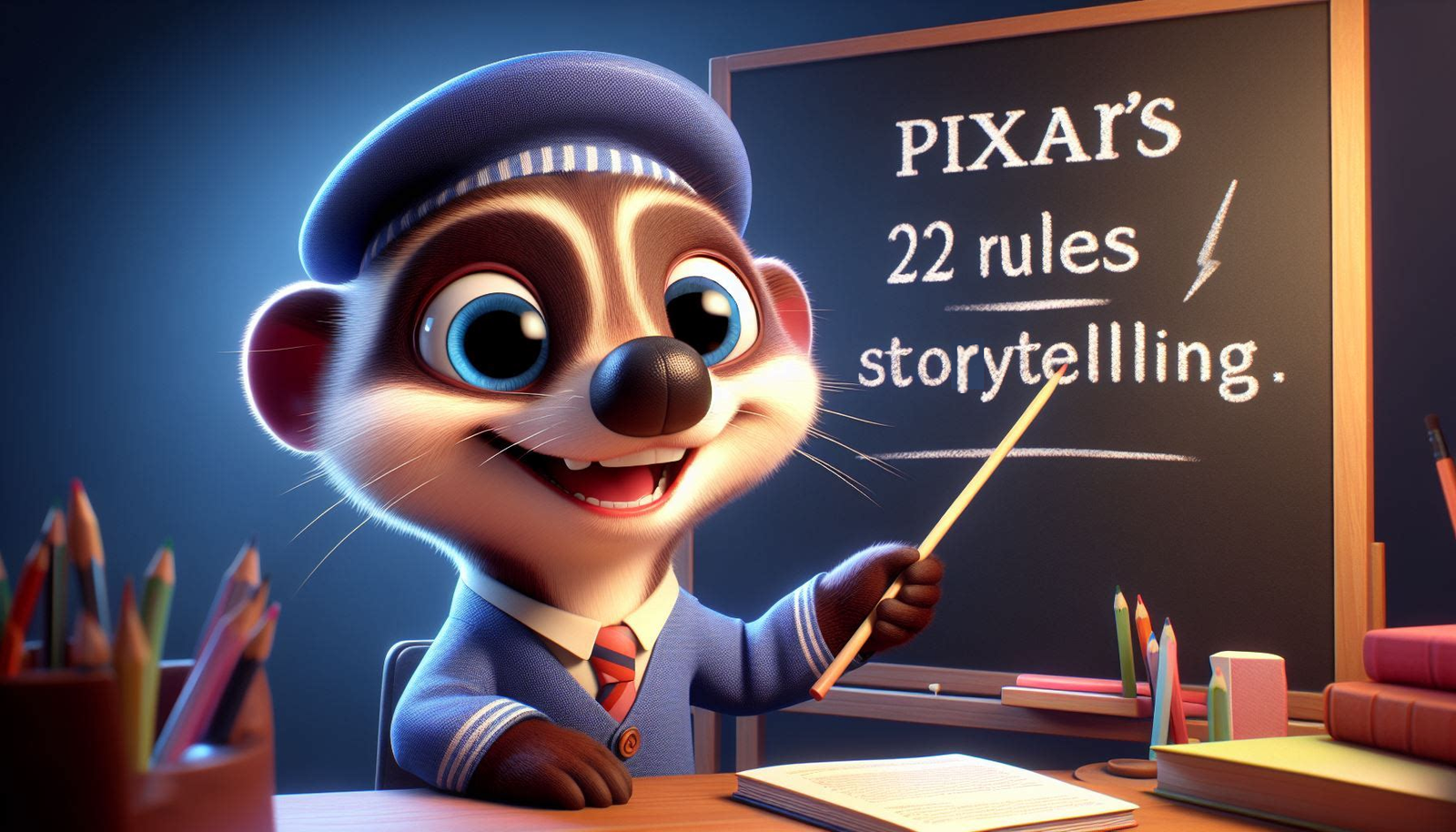
Pixar’s 22 Rules of Storytelling Part 4.

It’s the final installment! If you have ever researched rules in storytelling, you may have come across the famous Pixar’s 22 Rules of Storytelling. This came from a 2011 tweet from a Pixar employee who realized there were 22 written (and unwritten) rules they implemented on every story. While Industrial Scripts does a pretty good job of explaining the rules, I thought it would be fun to expand on them here in regards to books. After all, while there are many books made from their stories, Pixar makes movies. In part 1, I discussed rules 1-5. In part 2, I covered rules 6-10, and in part 3, I examined rules 11-16. Now, in the final installment: Pixar’s 22 Rules of Storytelling Part 4, I’ll finish with rules 17-22. Let’s get started!

#17: No work is ever wasted. And if it’s not working, let go and move on—if it’s useful, it’ll show up again.

I have a few documents from over the years of unfinished stories. Sometimes I stop at the end of a chapter, other times I will stop mid-sentence. As a writer, you know when you’re licked, and it is time to move on. However, I cannot tell you how many times I have recycled a story idea. Something I scribbled onto a notepad years ago, turned into an award-winning short story I wrote for a college class. A scrapped outline for a steampunk mystery became a novel I co-wrote last year with ChatGPT. If you are stuck, write something else for a change. If you can’t stop thinking about it, you’ll return to it eventually.

#18: You have to know yourself, and know the difference between doing your best & being fussy. Story is testing, not refining.

This rule stumped me. In my writing journey, I have been told to get out the first drafts, so I can fix it. Refine it. So, what does this rule mean that story is testing, not refining? Recently, I gave a speech at my brother’s wedding. I made it humorous so that I wouldn’t cry, and that I wouldn’t be too nervous delivering the speech. However, I practiced the speech a few times. I read it out loud to my parents. I tested it. A story is no good if only the author reads it. Stories are meant to shared. I think this is what the rule is getting at. You can refine all you want, but you have to eventually test the story. Does it resonate with other people? If not, then all you have is a polished Word document that ends up taking space on your hard drive.

#19: Coincidences that get characters into trouble are great. Coincidences that get them out of it is cheating.

This is my favorite rule, and the most challenging. As a Christian writer, I find myself using the deus ex machina trope. I know in my own life, God has orchestrated miracles through “coincidences.” However, there are problems when we apply this idea to our writing. First of all, it can come across as unbelievable. We have all rolled our eyes at a story where everything falls into place. It can be cheesy. Second, I have also had times when God did not “swoop in and save the day” the way I wanted Him to. It can be just as dangerous to misinform children of how God answers our prayers. In this world we will have trouble. Having coincidences as a bad thing can also reflect the spiritual warfare that we as Christians endure in this life. And it just makes for a more engaging story.

#20: Exercise. Take the building blocks of a movie you dislike. How would you rearrange them into what you DO like?

I may or may not have illegally downloaded a movie and edited out the parts I didn’t like. If I did, then I definitely did it long enough ago that the statute of limitations has passed. But let’s say you do this with a book. Perhaps a classic book from the public domain! Edit it. Rearrange it. See how you can change the story into something that you like. I hate tragedies. Growing up, my brothers and I used to joke around about how you could rewrite tragic endings and give them happy Disney endings. But if you lean more toward the gothic side, take a happy ending, and make it a tragic ending. There is nothing more satisfying than coming up with a better ending to a story someone else wrote. Whether you do it mentally, or on paper, try it out.

#21: Identify with your situation/characters. Don’t write “cool.” What would make YOU act that way?

This is why I switched to first-person and never looked back. I am not an adventurer in real life. While I used to enjoy having courageous protagonists, they have begun to ring hollow to me. I have met courageous and confident people in real life, and frankly, they can rub me the wrong way. Write what you know? Well, I know fear, anxiety, and self-doubt. While it may not be “cool” it allows me to know exactly how my main character would act. It offers the authenticity my stories had been missing. What is your personality? Write your characters from that place.

#22: Putting it on paper only allows you to start fixing it. If a perfect idea stays in your head, you’ll never share it with anyone.

What did I tell you? Stories are meant to be shared. There are story ideas that I have had since I was fifteen. Still roaming around my head, I revisit them from time to time like sweet memories. They are perfect ideas, and if I ever try to put them onto paper, they will lose their luster. But isn’t that the case with real memories that we share? Like wine, they get better with age. This is because we begin fixing them, each time we tell them. Sometimes we stretch the truth, other times, we rearrange the information, but either way, the more times you tell a story, the better it gets. Stories are meant to be shared, and until we put them onto paper, we cannot fix their flaws.

Well, that wraps up all of Pixar’s 22 Rules of Storytelling. What is your favorite this time? How will you implement these rules into your stories? Let me know in the comments!

Author Bio

Just like his two older brothers, Kyle Morgan was homeschooled from Kindergarten through High School. When he is not busy writing, the next classic children’s book, Kyle loves spending time with his family, all things baseball, and watching black and white movies. He is a monthly contributor to Write2Ignite where he blogs about writing for children. His work has appeared in The Old Schoolhouse Magazine, The Caldwell Perspective and StarLight Magazine. You can check out his Facebook page or follow him on Instagram.

Pixar’s 22 Rules of Storytelling Part 3.

If you have ever researched rules in storytelling, you may have come across the famous Pixar’s 22 Rules of Storytelling. This came from a 2011 tweet from a Pixar employee who realized there were 22 written (and unwritten) rules they implemented on every story. While Industrial Scripts does a pretty good job of explaining the rules, I thought it would be fun to expand on them here in regards to books. After all, while there are many books made from their stories, Pixar makes movies. In part 1, I discussed rules 1-5. In part 2, I covered rules 6-10. in Pixar’s 22 Rules of Storytelling Part 3, I’ll cover rules 11-16. Let’s get started!

11. Why must you tell this story in particular? What’s the belief burning within you that your story feeds off of? That’s the heart of it.

            As Christian children’s authors, we may think we know what belief is burning within us to tell, but do we really know? Can we confidently say, “This story is about the importance of face-to-face interactions among friends in this digitized world?” Or “This is a lighthearted cautionary tale of the dangers of underage internet use?” The heart of the story isn’t always the sweet parts, but the part that you want the reader to walk away thinking about.

12. Discount the 1st thing that comes to mind. And the 2nd, 3rd, 4th, 5th—get the obvious out of the way. Surprise yourself.

            Want to hear a terrible joke? “A man walks into a coffee shop and orders a coffee.” Get it? No? It’s not funny because it is expected. Comedy is about the unexpected.

“A man walks into a coffee shop and orders a coffee. The coffee says, ‘Hey, you can’t order me around!’”

            Okay, so that’s a terrible joke as well, but for a different reason. This rule doesn’t mean that you have to make your story absurd and illogical. What it does mean, is that you must avoid the cliches and the obvious. In my WIP Pirated! You expect some kids who illegally download a movie from the internet to get in trouble with their parents. You DON’T expect that illegally downloaded movie to actually be a file that 3-D prints a walking, talking, character from the movie! Surprise yourself, and your reader with the 6th, 7th, or even 23rd idea that comes to mind.

13. Give your characters opinions. A character being passive or malleable is easy for you as a writer, but it’s poison to your audience.

            I used to think that conflict was uncomfortable. I don’t like it in real life, why would I like to write about it? But have you ever told someone a story about your day where there was no conflict? Crickets.

“I lost my keys the other day.”

            “Oh no! How did you get inside your car?”

            “I didn’t. I remembered I don’t have a car, so I took the bus instead.”

            Stories without conflict are those awkward moments at parties where nothing interesting is happening. If you tune out in real life, why would someone else read about that in your book? This rule of giving characters opinions is all about creating conflict. We meet people all the time who have opinions that are terrible. How could this person think this way? What is wrong with them? A butcher and a vegan on a deserted island would make some pretty interesting conflict, and keep your audience entertained. This is the magic between Lightning McQueen and Mater. Boy, those two cars have very different opinions, and it makes their friendship all the more engaging.

14. What’s the essence of your story? What’s the most economical way of telling of it? If you know that, you can build out from there.

            When I was taking a creative writing class at my local community college, we were tasked with writing a short story. Instead of coming up with a new idea, I looked at my old novel ideas (I had dozens of them) and decided to compact my novel idea into a short story. And guess what? That short story won the President Writing Award for best short story! Not because I was thinking of how to tell a small story, but how to tell a big story, in as compact of a way is possible. I boiled down my idea to the just the essence.

15. If you were your character, in this situation, how would you feel? Honesty lends credibility to unbelievable situations.

            This is why I switched to 1st person narration and will likely never look back. I do not have the multiple personality disorders to head-hop. If I make my character me, then I can write from an honest perspective that makes my viewpoint unique. It also allows me to be slightly unreliable as a narrator, which means I can write other characters not exactly how they are, but how I perceive them. But you have to be honest about yourself. Your book version might be a little too heroic to be authentically you. I know in my head I am much cooler, and braver than in real life. So sometimes, my character has to stop before he leaps from one building to the next and realize “Oh my goodness! I am on a rooftop! I don’t even like being four steps up a ladder!” And the villain escapes, and my character hurries down the stairs as quickly as he can.

16. What are the stakes? Give us reason to root for the character. What happens if he doesn’t succeed? Stack the odds against him.

            Marvel’s Guardians of the Galaxy is an incredibly problematic film. I have a love-hate relationship with it. But one line that is absolutely brilliant, is when the main character is asked why he wants to save the galaxy. His reply? “Because I’m one of the idiots who lives in it!” For the longest time, my book ideas were filled with complex plots with subplots and sub-subplots. I thought you needed plot to make a good story, but it just isn’t true. The stakes have to be rooted in character. Have you ever read a book, watched an episode of television, or a movie where the character thought they wanted one thing, only to learn that what they really wanted was something else? Lightning McQueen giving up the Piston Cup? This is because the stakes are about character, not the plot.

            Stacking the odds against the character is another brilliant move. Don’t have just one obstacle for the character to get through. Make it everything. Make this situation a do-or-die kind of situation. It might not be a physical death, but it could be the death of the life he once lived. We want to see our hero win. But we want him to barely win. Luke 15:7 comes to mind here. There is more satisfaction when a hero overcomes all the obstacles than if it was obvious from the beginning that the hero was always going to win. Make the victory close. Make it seem impossible.

            Next month, I will finish this series. by taking on rules 17-22. In the meantime, what was your favorite rule in this blog post? Let me know in the comments!

Just like his two older brothers, Kyle Morgan was homeschooled from Kindergarten through High School. When he is not busy writing, the next classic children’s book, Kyle loves spending time with his family, all things baseball, and watching black and white movies. He is a monthly contributor to Write2Ignite where he blogs about writing for children. His work has appeared in The Old Schoolhouse Magazine, The Caldwell Perspective and StarLight Magazine. You can check out his Facebook page or follow him on Instagram..

Pixar’s 22 Rules of Storytelling

Mongoose teaches the Pixar's 22 rules of storytelling

If you have ever researched rules in storytelling, you may have come across the famous Pixar’s 22 Rules of Storytelling. This came from a 2011 tweet from a Pixar employee who realized there were 22 written (and unwritten) rules they implemented on every story. While Industrial Scripts does a pretty good job of explaining the rules, I thought it would be fun to expand on them here in regards to books. After all, while there are many books made from their stories, Pixar makes movies. So without further ado, let’s take a look at numero uno.

1: Admire characters for attempting more than what their successes have been.

Underdogs. We can’t get enough of them. And when you look at what makes Pixar movies so great, it is underdogs. WALL*E, Flick, Nemo, you name it. Kids love underdogs because they always feel like underdogs. When you’re a kid it can feel like everyone has more years and experience than you. But this rule is more than just that. This is about swinging for the fences. Persevering. Never giving up. Imagine a story about a poor wittle kid named “Ernest Humming” who wants nothing more than to hit a home run for his team. Only problem is he is the runt of the littler. Shorter than every kid in the league. The furthest he’s ever hit the ball was right in front of the pitcher’s mound. His attempt is far more than his past successes, but he doesn’t let that discourage him. His grit, determination, and optimism are the characteristics that make us root for him to the very end. We admire him for attempting more than he’s achieved in the past.

2: Keep in mind what’s interesting to you as an audience, not what’s fun to do as a writer. They can be very different.

Out of Pixar’s 22 rules of storytelling, this might be the most important rule to think about when writing for kids. As adults, we might be trying for the Newberry Medal, or a coveted library pick. However, there are two kinds of kids books. Ones that adults love, and ones that kids love. While it is possible to overlap, this is an important rule to keep in mind. Make it fun for them, not for you. Cars is consistently near the bottom when critics list the top Pixar movies. But guess what? It is usually the favorite of children ages 6 and younger. Why? Because it is fun for the intended audience. Cars go really fast and they talk in silly voices. It is simple, charming, and is all about something most kids see every day. Cars. It is so accessible. Both of my nieces love the movie and smile whenever they see a picture of Mater.

3: Trying for theme is important. However you won’t see what the story is about until you’re at the end of that story. Got it? Now rewrite.

As Christians, we want to come up with a theme first, then write the story. But as this rule points out, you don’t know what the theme is until you’ve written it. Back when I was trying to write scripts, I adapted the Shakespeare comedy As You Like it. I listened to podcasts, read reviews and articles about the themes of the play, but it wasn’t until I recently looked at my version that I realized my theme was about soulmates vs. free will. Do soulmates exist? If so, do we have the free will to mess that up? Now the theme is clear, but when I was writing it, I thought I was writing about how marriage takes hard work. WALL*E probably has my favorite theme of all the Pixar movies. No, not the “save the planet before we destroy it” but the real theme: love. I read one time that the director wanted to tell a story about how humans had forgotten how to love each other. And that it took a robot for them to realize how to love again. That’s the heart and soul of the movie. Love.

4: Once upon a time there was ____. Every day, ___. One day ____. Because of that, ___. Until finally ____.

If you have writer’s block, this will fix it. A simple format? Perhaps. But the possibilities are endless. Let’s take my earlier example and plug it in.

Once upon a time there was a little boy named “Ernest Humming”. Every day, he dreamed about hitting a home run for his baseball team. Because of that, he trained hard including through the winter. Until finally, at the last game of the season, he hit an inside the park home run.

It’s not groundbreaking. But then again, the best storytelling isn’t. If you break new ground, how can the reader relate? Stick to the tried and true methods and give your kid reader a satisfying story that rivals Pixar itself.

5: Simplify. Focus. Combine characters. Hope over detours. You’ll feel like you’re losing valuable stuff, but it sets you free.

The harsher version of this is the classic “kill your darlings” but it means the same thing. Simplify. Focus. Trim. Cut out anything that doesn’t advance the plot. I know I learned this when I was taking a creative writing class at my local community college. We were supposed to write a short story. I had never written one before, but I had plenty ideas for novels, so I “adapted” one of my ideas. I was amazed at how I could still keep the essence of the story with only a few thousand words. Trim the fat. Strengthen the muscles, and you’ll find your story is stronger than ever.

By focusing on your character, keeping your audience in mind, learning your story’s theme, structuring it, and simplifying it, you are on the right track to creating a story worthy of the Pixar name. And since it is impossible to fit all of Pixar’s 22 rules of storytelling into one blog, be on the lookout for the next installments. In the meantime, what is your favorite Pixar movie? Let me know in the comments!

Just like his two older brothers, Kyle Morgan was homeschooled from Kindergarten through High School. When he is not busy writing, the next classic children’s book, Kyle loves spending time with his family, all things baseball, and watching black and white movies. He is a monthly contributor to Write2Ignite where he blogs about writing for children. His work has appeared in The Old Schoolhouse Magazine, The Caldwell Perspective and StarLight Magazine. You can check out his Facebook page or follow him on Instagram.