

"Behold, I have come to you! Have I now any power of my own to speak anything? The word that God puts in my mouth, that I must speak."
--Numbers 22:38 (ESV) Tweet
One of the most important questions a writer can ask of themselves is who is my audience? When we’re crafting a story, we need to keep in mind who we want to read our words. Do we want to engage preschoolers or middle-schoolers? What market do we want to publish in, secular or Christian? Do we hope to have our stories read in schools as a teaching tool, or do we want to write for the individual child reading at home? Our intended audience has a significant influence on how we choose to tell our stories. Even so, we need to be careful not to let our audience distract our focus from writing to glorify God. First and foremost, we need to obey God and speak the words He gives us. While our audience should guide how we write, the Lord should guide the foundational message of our words.
The Danger of A Shifting Focus
In the book of Numbers, we find a powerful narrative which shows the danger of letting your audience shift your focus and your core message along with it. Numbers chapters 22-24 follow the story of Balaam, a famous prophet at the time of Moses. Balak, the king of Moab, was frightened of the Israelites as they came into the region and camped nearby. The Israelites had just defeated the Amorites, and Og the king of Bashan. So Balak in his fear sent messengers to Balaam to ask the prophet to come and curse the Israelites so the people of Moab might defeat them.
At first, it seems that Balaam has an obedient heart to the Lord. God tells Balaam, “You shall not go with them. You shall not curse the people, for they are blessed,” (Numbers 22:12). Balaam responds by sending the king’s messengers back and refusing the king’s request. However, Balak is persistent. He sends more messengers and promises Balaam more honor and rewards for cursing Israel.
Balaam replies with a humble statement, “Though Balak were to give me his house full of silver and gold, I could not go beyond the command of the Lord my God to do less or more,” (Numbers 22:19). Yet, despite the fact that God already gave him an answer, Balaam asks the messengers to stay the evening, while he asks the Lord what he should do. We find that from the context of the rest of the narrative, as well as a reference in 2 Peter 2:15, that Balaam’s ways were not right. He was more focused on the promises of the messengers than on the words God had already spoken to him.
A Donkey’s Correction
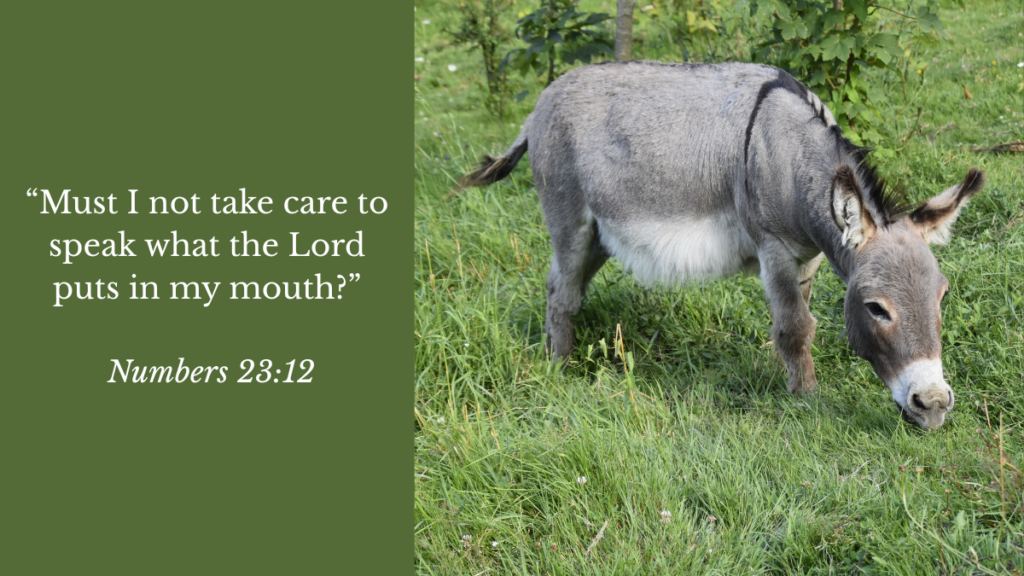
When Balaam rose the next day and immediately went with the princes of Moab, God’s anger was kindled against him. The Lord sent an angel with a flaming sword to block his way three times. Three times, Balaam’s donkey turned aside and finally stopped. Three times, Balaam struck his donkey in anger. Then the Lord did an incredible thing. God opened the mouth of the donkey and let her speak.
After the donkey questioned Balaam on why he struck her, the Lord opened Balaam’s eyes to see the danger that his donkey had protected him from. In that moment, Balaam realized his wrongdoing. The angel repeats God’s command that Balaam go to Balak, but to only speak what the Lord gives to him. After hearing the speech of a donkey and seeing the angel of the Lord, Balaam’s focus is back where it ought to be. He is ready to obey God with his words.
Focused on Pleasing God and Not Man
In chapters 23-24, we hear the messages Balaam receives from God. Four times, Balak asks and expects Balaam to deliver a curse on his enemies. Instead, Balaam stands before the king and all of his princes and speaks blessings over Israel. Though at the beginning of his story, Balaam seemed swayed by the king’s promises, now he speaks with obedience the words the Lord puts in his mouth.
Needless to say, the king isn’t pleased. He berates Balaam for not speaking curses over Israel. Balak brings the prophet to different spots in hopes of changing Balaam’s mind. When he doesn’t get the answer he wanted, Balak tells Balaam to flee, asserting that, “The Lord has held you back from honor,” (Numbers 23:11).
In the eyes of man, Balaam’s message was infuriating. Here the prophet was, being promised riches and honor, and instead he refused to do the job that the king had asked. Instead of helping to bring destruction to the king’s enemies, Balaam proclaimed the message that Moab would be the one destroyed. His message went against everything his audience wanted to hear, but followed exactly what the Lord wanted him to speak.
How to Keep A Right Focus in Writing
In our writing, we face an important choice. Do we write stories that please the Lord? Or do we shift our message to please our audiences? Sometimes it can be tempting to make small changes. To leave out hard truths because they might be unpopular. To add details to our work that don’t fit the message God gave us, because they fit what a publisher is looking for. While there are changes we can include to make our stories more marketable, we need to make sure those changes don’t shift the truth of the story.
To keep the right focus, we should take time to pray over our work, asking that God would guide our words. We should spend time in Scripture, building the foundation of our faith so that we can write from the overflow of the heart. Finally, we should constantly remind ourselves that we are writing to glorify God, before anything else. When worries arise over what people may think of our message, keeping our eyes fixed on the Lord will give us strength to continue writing stories that point back to Him.

Karley Conklin
Karley Conklin is a librarian by day, a writer by night, and a bookworm 24/7. For more of her writing, visit litwyrm.com.
6 Responses
This is great, Karley. A good reminder and a devotional!!
Thank you, Carol!
Thank you for this reminder!
Amazing truths!
This leaped out to me: To add details to our work that don’t fit the message God gave us, because they fit what a publisher is looking for.
How many of us have done this? I think it’s out of fear we might not get picked up. But what I’ve learned over the years is to trust the message God has given me. He will decide when and how I get published.
It’s not easy somedays to wait on Him, but I have to remind myself it’s good to wait on the Lord.
These are great lessons from the Bible story of Balaam and his donkey!